
Last updated September 21, 2026
Free on-site gate assessment - hinges, posts, and your LiftMaster or Nice gate operator checked before anything is quoted
The assessment is free and the quote is the invoice.

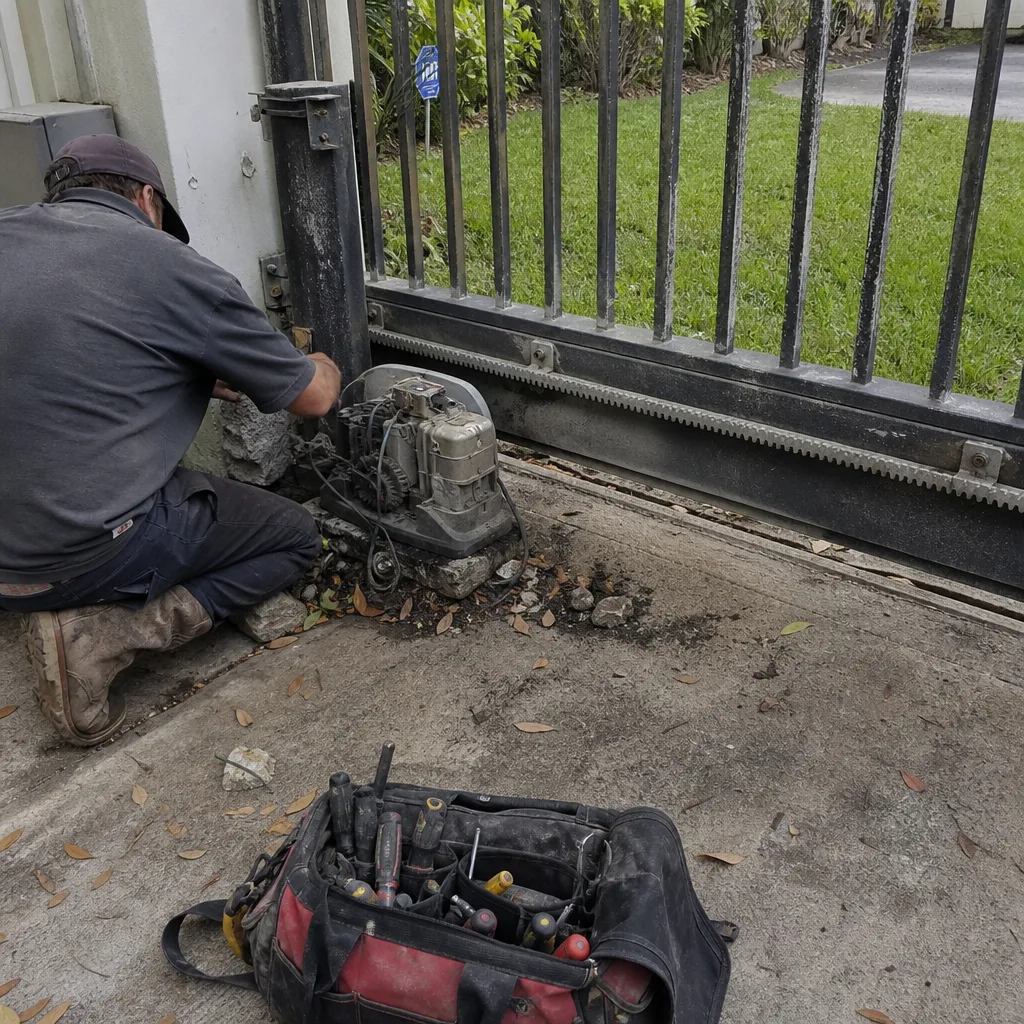 Before
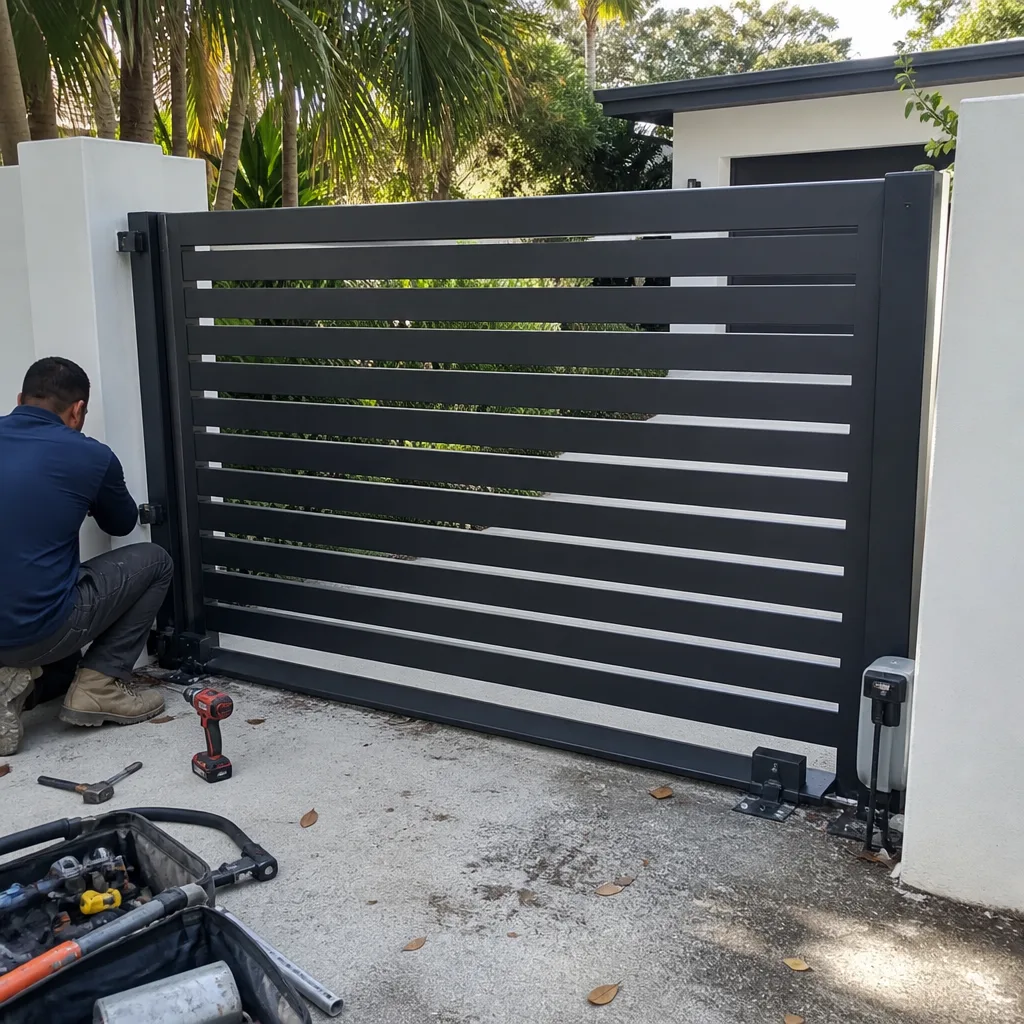 After
After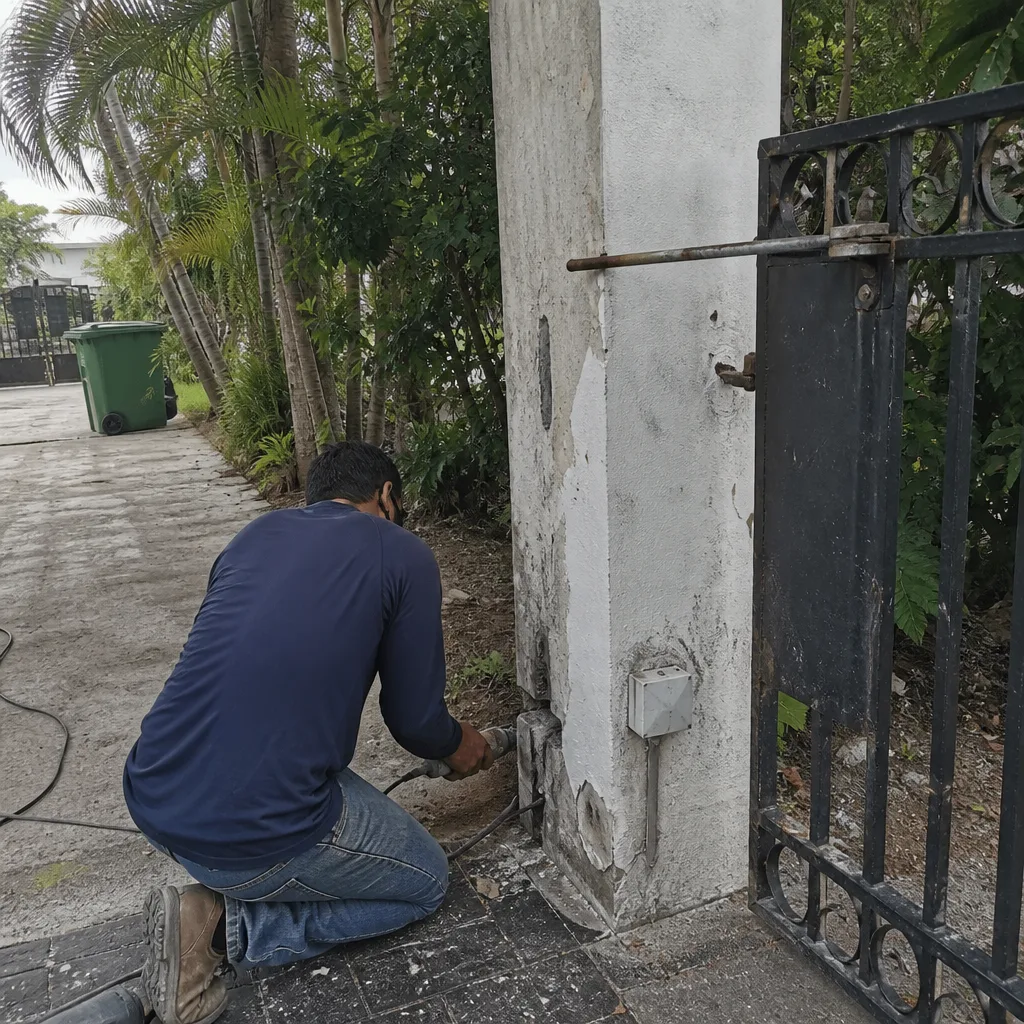 Before
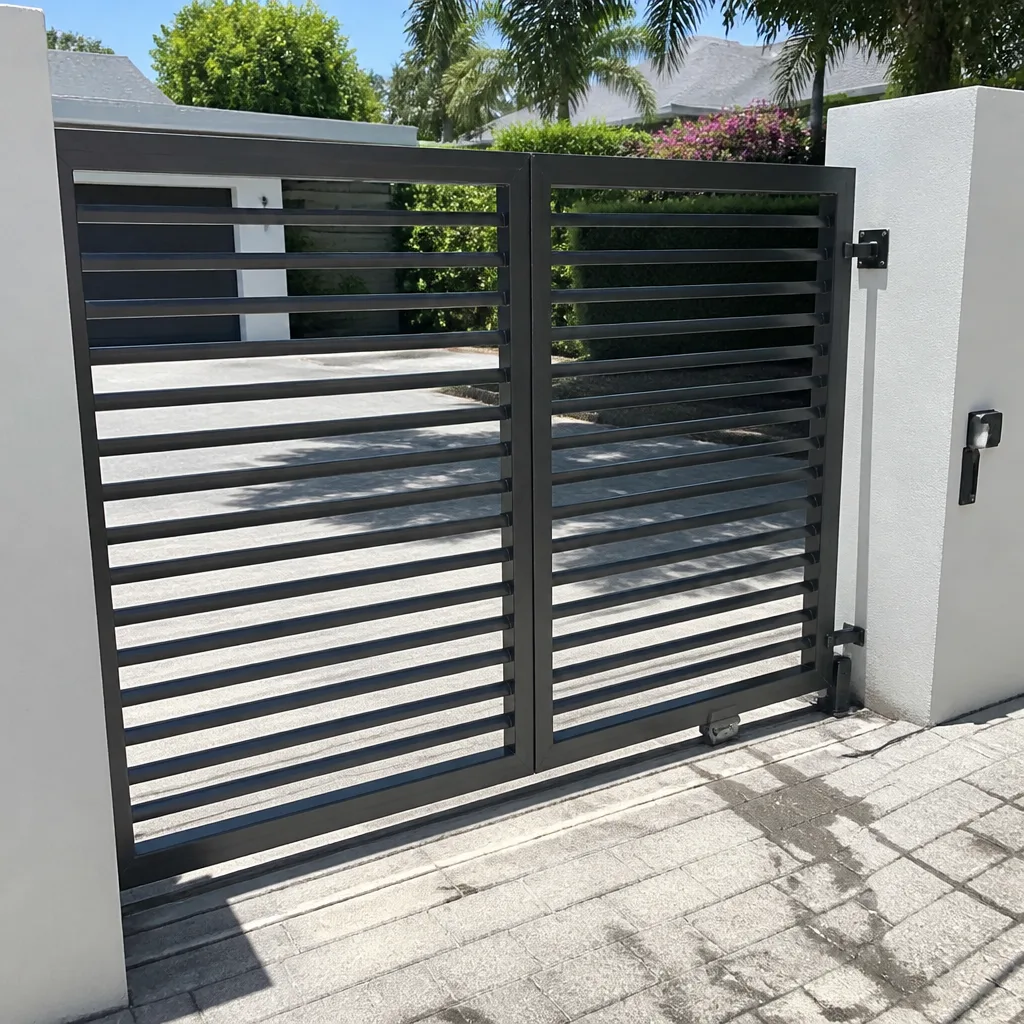 After
After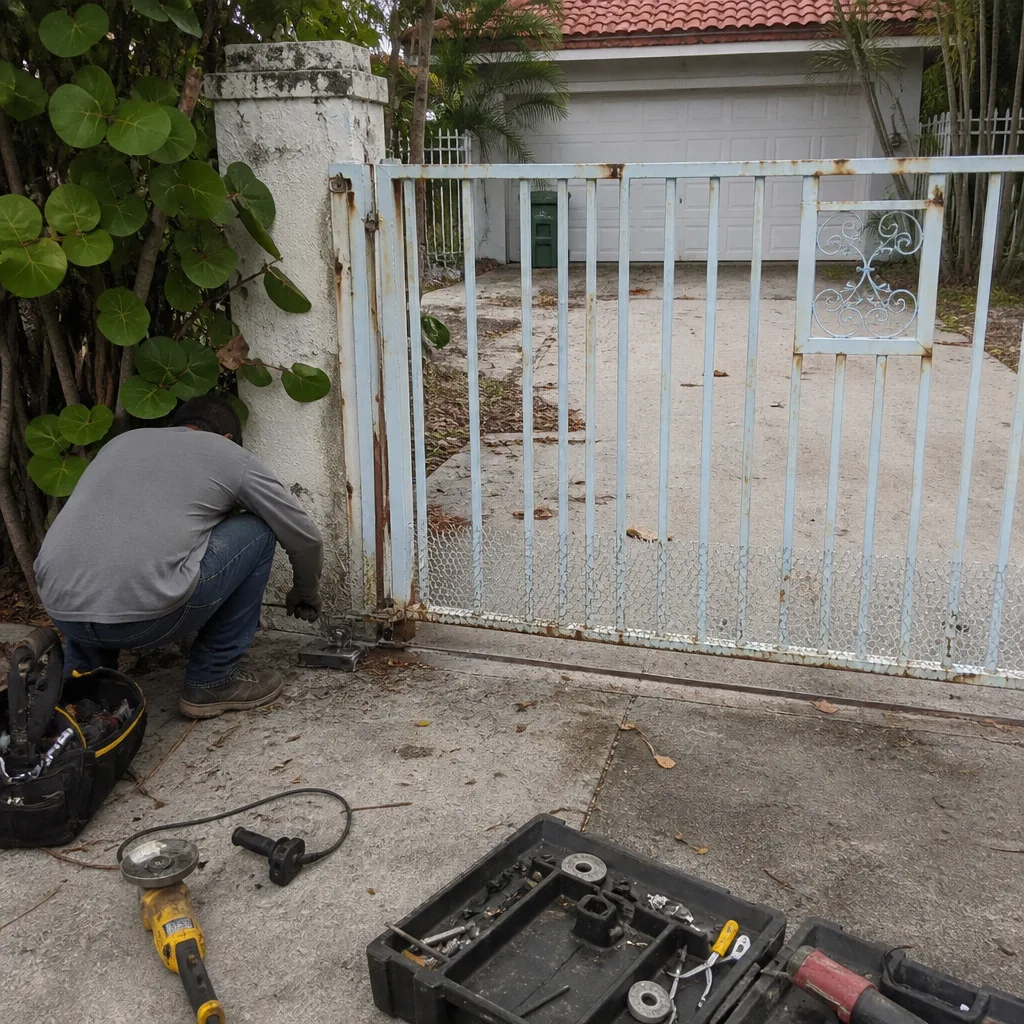 Before
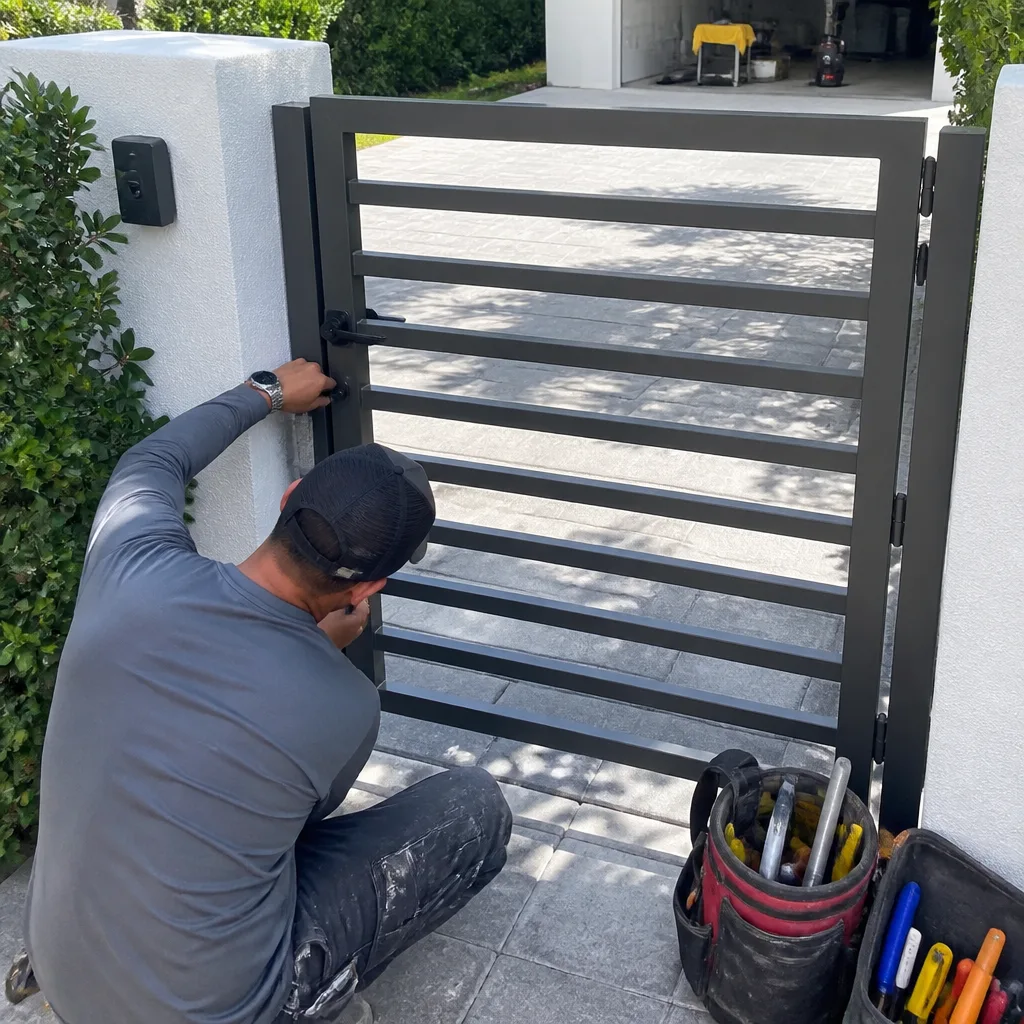 After
AfterGate Repair Warning Signs: A Miami Beach Homeowner’s Reference Guide
A gate that hesitates for two seconds before moving is not working fine. It is an operator drawing above-threshold amperage to overcome mechanical resistance, and the motor winding is failing in slow motion. In Miami Beach, where salt air accelerates corrosion and afternoon thunderstorms fry control boards, most gate failures announce themselves with measurable symptoms weeks before the gate stops completely. Homeowners dismiss these signs because they look minor: a slight lag, a new sound, a remote that needs two presses. This guide-along with our Seasonal Gate Repair Care for Miami Beach: Year-Round Homeowner’s Guide-translates each warning sign into its specific cause, a realistic failure timeline, and a repair priority level so you can make an informed decision instead of a panicked one at 6 a.m. on a Monday.
Quick Answer
Gate failure in Miami Beach typically shows five measurable warning signs before total breakdown: hesitation (indicating motor strain), grinding (gear wear), intermittent response (failing circuit board or loose connection), visible corrosion at weld points or hinges, and reversed or incomplete travel (limit switch drift). A homeowner who documents these symptoms with photos and notes can often diagnose the failure category before the technician arrives, cutting diagnostic time and avoiding unnecessary parts replacement.
Table of Contents
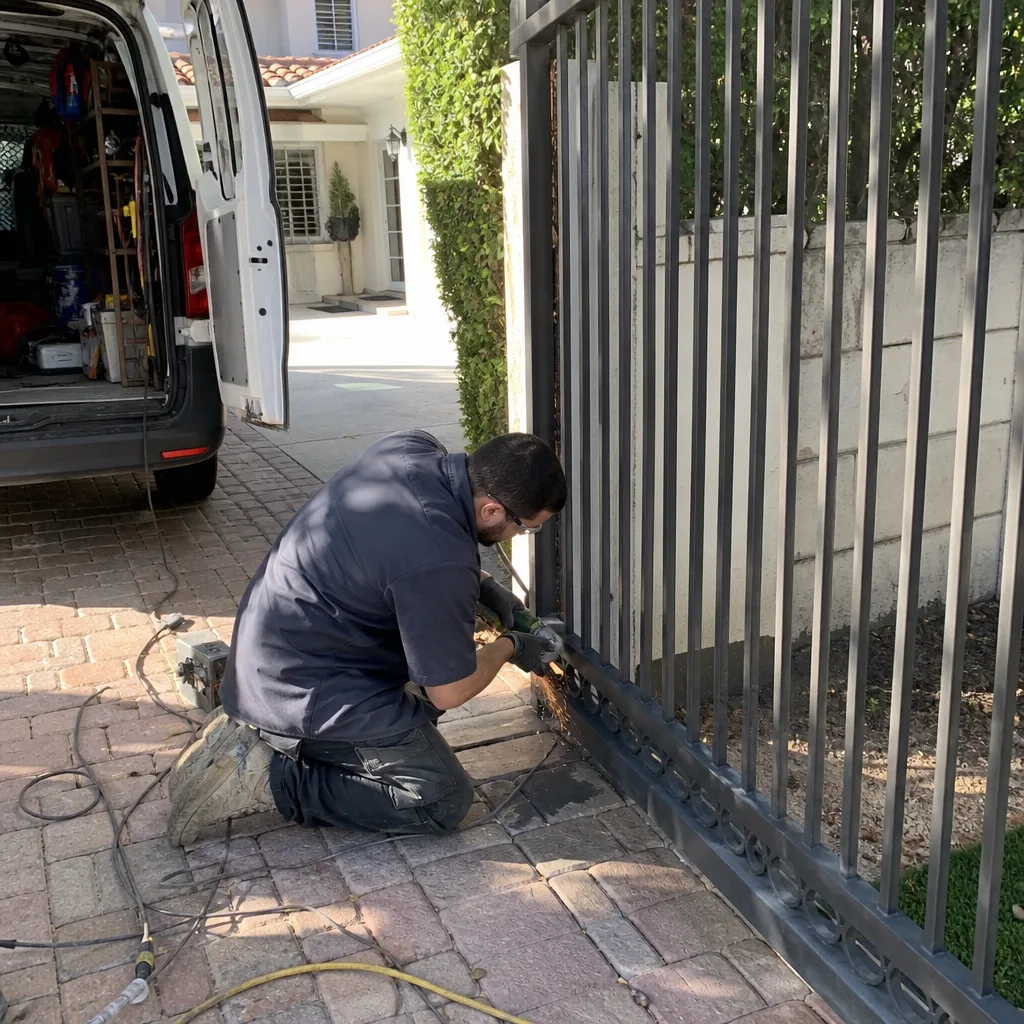
- Hesitation: The Two-Second Warning That Saves Your Motor
- Grinding Sounds and What They Reveal About Gear Health
- Intermittent Failures: Why “Sometimes Works” Is Worse Than “Never Works”
- Reading Corrosion in Miami Beach’s Salt Air Environment
- Reversed or Incomplete Travel: Limit Switch and Obstruction Logic
- How to Distinguish Motor Failure from Board Failure with a Multimeter
- What to Photograph and Record Before Calling a Technician
- Failure Timeline: From First Symptom to Complete Stop
 Before
 After
AfterHesitation: The Two-Second Warning That Saves Your Motor
The most commonly ignored warning sign is also the most diagnostically specific. When a swing gate or slide gate pauses between the remote command and actual movement, homeowners tend to adapt. They press the button earlier. They walk slower toward the car. That two-second delay is the operator’s motor drawing locked-rotor amperage, sometimes 3-4 times its normal running load, to break static friction in a degrading gearbox or overcome a binding hinge.
Normal inrush current on a residential swing-gate operator like a Linear LA500 or Viking G-5 lasts roughly 0.3-0.5 seconds. When it stretches past one second, the motor windings are operating outside their thermal design. Repeated daily cycles at elevated amperage cook the insulation. The failure mode is predictable: the motor runs hotter, the lubricant in the gearbox breaks down faster, and the mechanical load increases in a spiral that ends with a thermal overload trip or a seized arm.
In Miami Beach, hesitation has an additional regional cause. Salt accumulation on the gate’s hinge pins and track rollers creates microscopic pitting. The surface feels smooth to a finger, but under load the irregularities increase friction by 15-30 percent. We’ve measured this on gates in South Pointe and Mid-Beach properties where the ocean exposure is direct. The operator compensates until it cannot.
Repair priority: HIGH. Hesitation is reversible if caught early. A hinge service, track cleaning, and gearbox lubrication from our Gate Repair services typically cost $140-$220 in the Miami Beach market. Motor replacement after thermal damage runs $680-$1,200 depending on brand and arm configuration.
What to check yourself:
- Time the delay from button press to gate movement with a stopwatch. Under 0.5 seconds is normal. Over 1.0 seconds is actionable.
- Listen for a hum before movement. A sustained hum indicates the motor is energized but mechanically blocked, which is more urgent than a silent delay.
- Feel the hinge pins after a cycle. Warmth indicates friction; they should stay near ambient temperature.
Document the delay duration, the hum presence, and hinge temperature in your notes. Under Vance Gate Repair Miami Beach Haven Standard Clause 4, we photograph the amperage draw on our multimeter during diagnosis and leave that image in your job record.
Grinding Sounds and What They Reveal About Gear Component
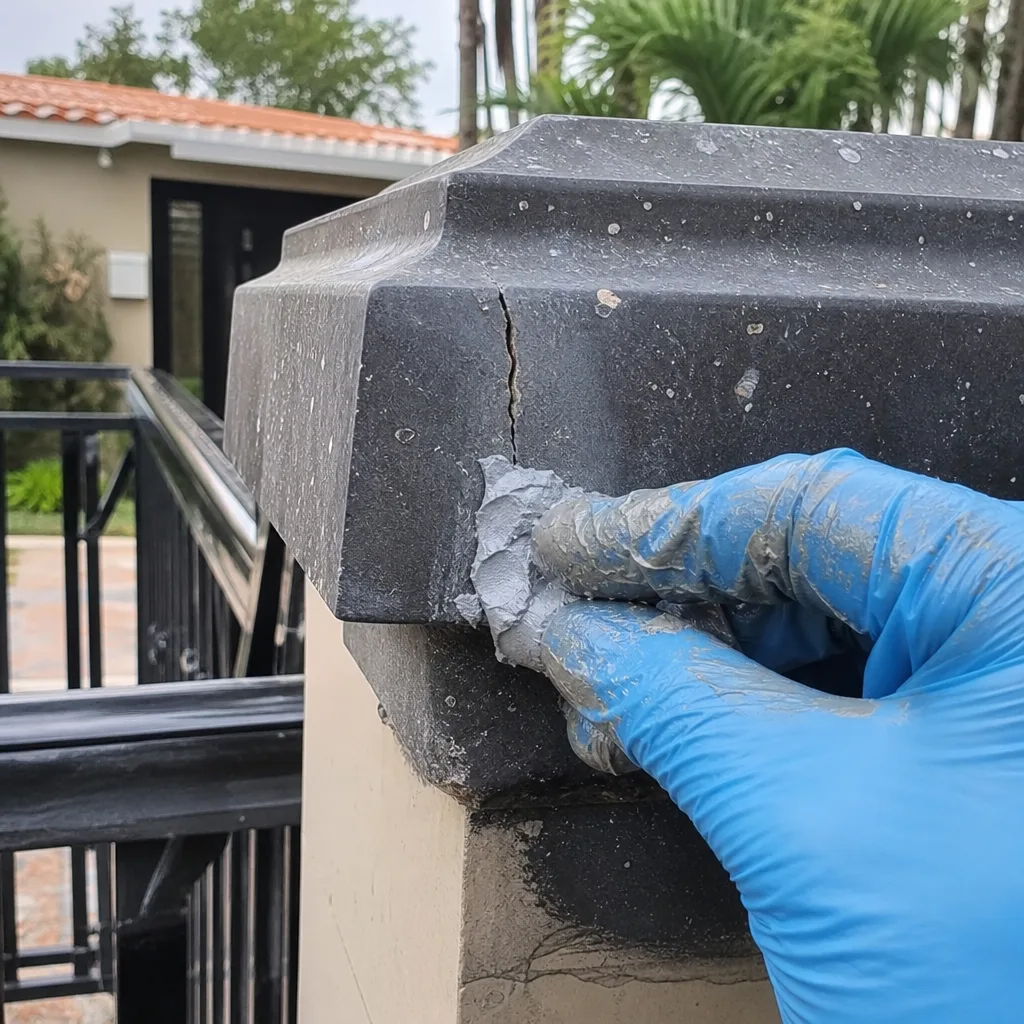
Not all grinding sounds indicate the same failure. The frequency, timing, and location of the noise map directly to specific components. Learning to distinguish them prevents the common mistake of replacing a perfectly good motor when the problem is a $12 bronze bushing.
Low-frequency grinding during acceleration (a deep growl in the first third of travel) typically indicates worm gear wear in the operator gearbox. The worm, a screw-like gear that translates motor rotation to arm movement, develops flattened crests after roughly 8-12 years of service in Miami Beach’s climate. The growl is the worm skipping against the worn bronze wheel. Ghost Controls and Linear operators use this architecture; the repair is a gearbox rebuild or replacement, not a motor swap.
High-frequency grinding throughout travel (a metallic whine that persists) points to track or roller degradation on slide gates, or hinge seizure on swing gates. The sound is the gate structure vibrating against its own binding points. On aluminum gates, which are common in Miami Beach for corrosion resistance, this vibration can crack weld points over time because aluminum lacks the fatigue resistance of steel under oscillating stress.
Grinding that stops abruptly mid-cycle is the most specific signature. It indicates a limit switch failure. The operator drives the gate toward its programmed stop point, the limit switch fails to register arrival, and the motor continues into mechanical hard stop. The grinding is the motor stalling against the gate’s physical end. The silence that follows is the thermal overload opening or the control board detecting overcurrent and shutting down. This pattern is common in BFT operators after lightning events, which are frequent in Miami Beach’s summer storm season.
Repair priority by sound:
- Low-frequency, acceleration-only: MEDIUM. Schedule within two weeks. Gearbox rebuild $340-$580.
- High-frequency, continuous: HIGH. Address within one week. Hinge or track service $180-$320; weld repair $280-$450 if caught before structural failure.
- Grinding-then-silence: EMERGENCY. Do not cycle the gate again. Limit switch replacement $160-$240; control board replacement $380-$620 if the overcurrent event damaged output relays.
We’ve documented this sound-mapping approach on over 22,000 gates since 2014. The photo record we leave with you includes a spectrogram app screenshot when the sound is ambiguous, so any future technician hears what we heard.
Intermittent Failures: Why “Sometimes Works” Is Worse Than “Never Works”
A gate that fails every third cycle is more dangerous than one that fails every cycle. Homeowners with consistently failing gates call promptly. Those with intermittent failures develop workarounds: the double-press, the walk-up-and-push, the “it always works if I stand right here.” These adaptations mask a deteriorating condition and delay diagnosis until the failure becomes total, often at the worst possible moment.
Intermittent failure has three root causes in Miami Beach, and each leaves a different evidence pattern.
Thermal intermittent: The gate works cold, fails after three or four cycles, then works again after cooling. This indicates motor winding insulation breakdown. The resistance of a failing winding increases with temperature; at 70°F the motor draws normal amperage, but at 140°F internal winding temperature the resistance drops enough to trigger the board’s overcurrent protection. Miami Beach’s summer ambient temperatures, often 85°F by 9 a.m., compress the failure window. A motor that fails thermally in July may appear reliable in January.
Connection intermittent: The gate works when the control box lid is closed, fails when wind vibrates it open. Or it works dry, fails in rain. These are loose terminal screws, corroded wire nuts, or failing solder joints on the circuit board. Salt air accelerates this dramatically. We’ve found green copper oxide blooms inside supposedly sealed Viking control enclosures on oceanfront properties in North Beach where the salt fog penetrates gasket seams.
Logic intermittent: The gate responds to the remote but not the keypad, or opens but won’t close. This is rarely the motor. It indicates a failing input circuit on the control board, a drifting safety sensor, or a ground-fault condition in the low-voltage loop. These are the most misdiagnosed failures because they mimic obstruction responses.
Why intermittent is worse: Each successful cycle after a failure event degrades the component further. A thermal intermittent motor experiences additional heat stress. A connection intermittent arcs at the loose joint, carbonizing the contact surface and increasing resistance. The failure accelerates nonlinearly. The gate that worked Monday through Wednesday and failed Thursday is the same gate that will work once Friday morning and not again.
Repair priority: HIGH for all intermittent categories. Do not wait for consistency. Thermal motor replacement $680-$1,200. Connection repair $140-$260 depending on access. Logic board or sensor replacement $220-$480.
Our Gate Repair in Miami Beach service includes free thermal imaging during diagnostic calls when intermittent failure is reported. The camera shows hot spots in windings and connections that no multimeter can catch in a static test.
Reading Corrosion in Miami Beach’s Salt Air Environment
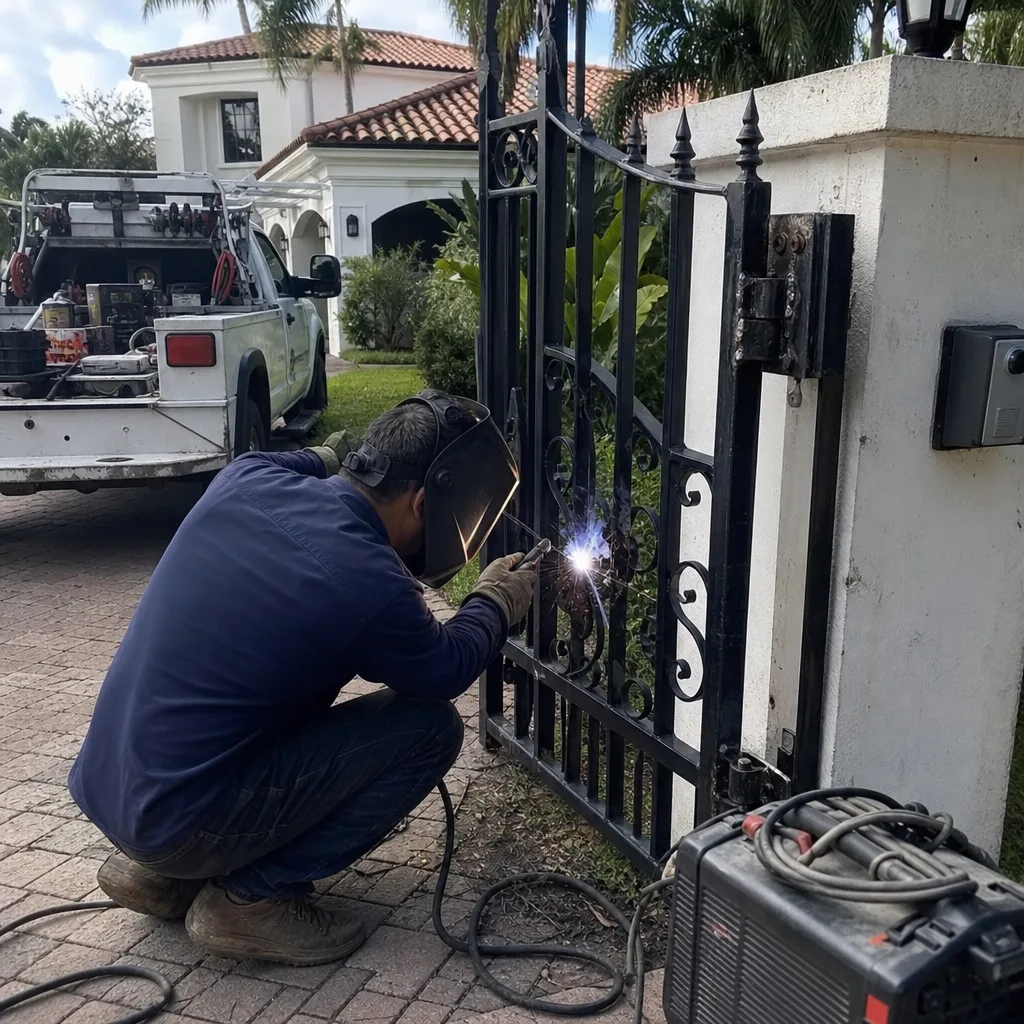
Miami Beach’s location on a barrier island creates a corrosion environment that inland Florida does not experience. Salt aerosol concentration is measurably higher within three blocks of the ocean, and the constant onshore flow keeps metal surfaces wet longer after rain. Gate corrosion progresses through distinct stages, and each stage has a different repair implication.
Stage 1: Surface oxidation. A light orange or white powder on steel, or a dull gray film on aluminum. This is cosmetic. It does not reduce structural capacity. On galvanized steel gates, this stage can persist for years without progression if the gate is rinsed periodically with fresh water. We see this on well-maintained properties in Flamingo Park and West Avenue where homeowners run a hose over the gate monthly.
Stage 2: Pitting. Small, sharp-edged craters in the metal surface, typically 0.5-2 mm deep. This is no longer cosmetic. Pitting creates stress concentrators that reduce fatigue life by 50-70 percent. A swing gate arm that cycles 4 times daily experiences roughly 1,460 load cycles annually. At 10 years, that’s 14,600 cycles. A pitted weld point or hinge bracket can fail suddenly under this cumulative loading. Pitting on load-bearing components requires welding repair or replacement.
Stage 3: Section loss. Measurable reduction in material thickness. On a 2-inch square steel gate frame, section loss of more than 15 percent compromises lateral stability. The gate develops visible sag or twist. On slide gates, section loss in the track support brackets causes the track to go out of parallel, increasing roller load and accelerating bearing failure.
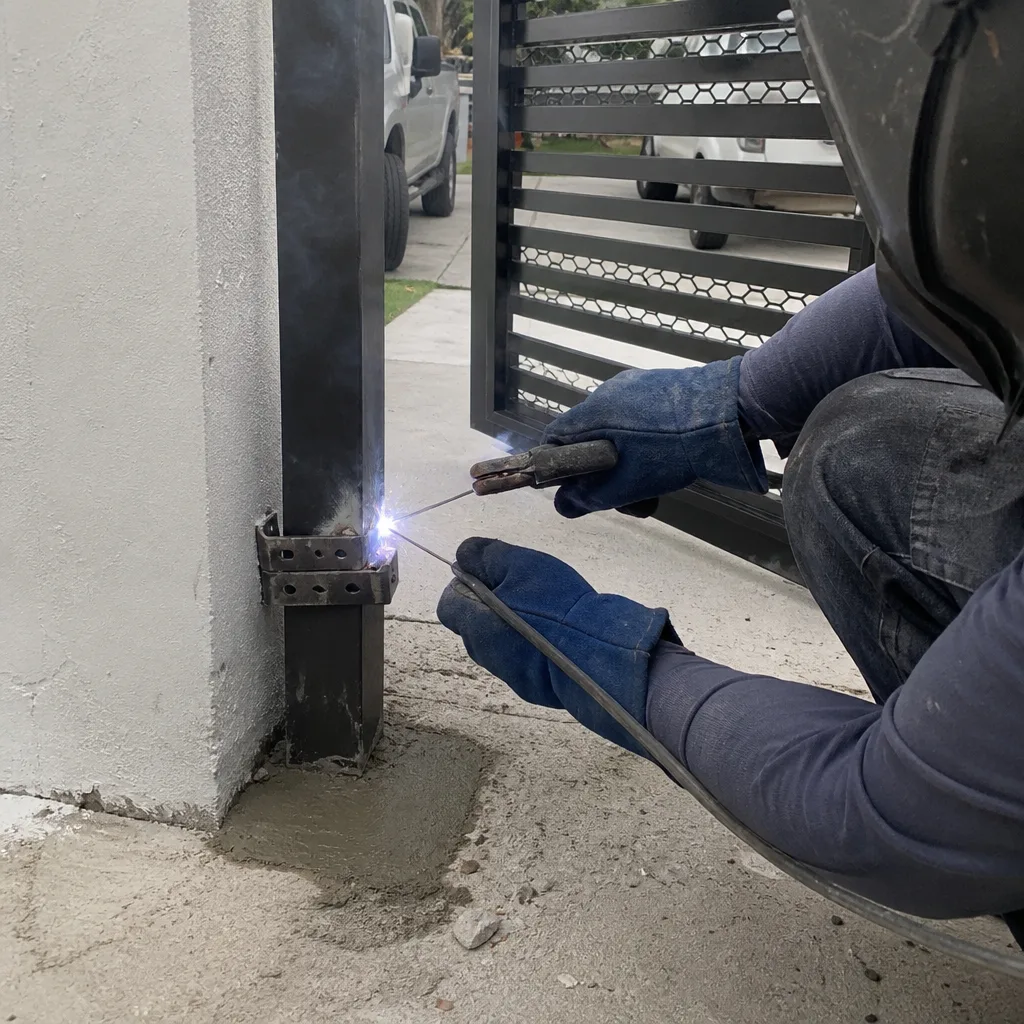
Stage 4: Structural compromise at weld points. This is the critical threshold. Welds are galvanically dissimilar to parent metal; they corrode faster. A weld that shows cracking, undercutting by corrosion, or visible separation is an imminent failure. Do not operate a gate with compromised welds. The sudden release of stored energy in a heavy steel or aluminum gate can cause property damage or injury.
Repair priority by stage:
- Stage 1: LOW. Schedule with routine maintenance. Cleaning and protective coating $120-$180.
- Stage 2: MEDIUM. Address within 30 days. Localized weld repair $280-$450; component replacement if pitting is widespread.
- Stage 3: HIGH. Address within two weeks. Structural reinforcement or gate replacement depending on extent. Gate Installation in Miami Beach for full replacement typically $2,800-$6,500 depending on material and automation.
- Stage 4: EMERGENCY. Cease operation immediately. Call for inspection same day.
We document corrosion stage with caliper measurements and photos at each annual service. Under Haven Standard Clause 4, you receive a dated corrosion log that tracks progression year over year. This prevents the surprise of discovering Stage 3 conditions when you assumed Stage 1.
Reversed or Incomplete Travel: Limit Switch and Obstruction Logic
A gate that opens when it should close, stops three feet short of full open, or reverses direction mid-travel without obstruction is reporting a control logic problem. These symptoms are often misdiagnosed as motor failure because the gate moves, just incorrectly. Replacing a motor in this condition wastes money and leaves the root cause unresolved.
Reversed travel (open and close commands swapped) has two common causes. After a power outage or lightning event, some operators default to reversed limit switch interpretation. The BFT Sub and Linear Pro models are particularly susceptible if the battery backup discharges completely. The fix is a limit switch relearn procedure, typically 10-15 minutes with the operator manual. The second cause is a failed relay on the control board that swaps motor polarity incorrectly. This requires board replacement.
Incomplete travel (stopping short of programmed open or close position) indicates limit switch drift. Mechanical limit switches use a cam that physically depresses a microswitch. The cam setscrew loosens over time, or the switch body shifts in its mount. Magnetic limit systems, used in higher-end operators, can drift if the magnet holder cracks or the sensor gap increases. In Miami Beach, thermal expansion of aluminum gates contributes: a 16-foot aluminum gate expands roughly 0.25 inches between a 65°F morning and a 90°F afternoon, which is enough to change the effective limit position on a tightly calibrated system.
Mid-travel reversal without obstruction is the safety system misbehaving. Photo-eye misalignment is the most common cause. The infrared beam, which should remain unbroken across the gate opening, gets intermittent reflection from wet pavement, passing vehicles, or even dense fog during Miami Beach’s winter morning marine layer. The operator interprets a momentary beam interruption as an obstruction and reverses. Edge sensors on the gate leaf itself can also false-trigger if the rubber housing cracks and water enters the switch.
Diagnostic sequence for travel problems:
- Check the operator’s LED display or fault code. Most brands flash a code: two flashes for open limit fault, three for close limit, four for obstruction. Record the code before calling.
- Measure the actual stop position versus the programmed position with a tape measure. Note whether the error is consistent or varies with temperature/time of day.
- Test the photo-eye by deliberately breaking the beam during travel. The gate should reverse. If it does not, the eye is already failed and the operator is running in bypass mode, which is a safety hazard.
- Inspect edge sensor housings for cracks or water intrusion. The sensor should click audibly when the rubber bulb is compressed.
Limit switch service $140-$220. Control board replacement $380-$620. Photo-eye realignment or replacement $120-$180. Edge sensor replacement $160-$240.
How to Distinguish Motor Failure from Board Failure with a Multimeter
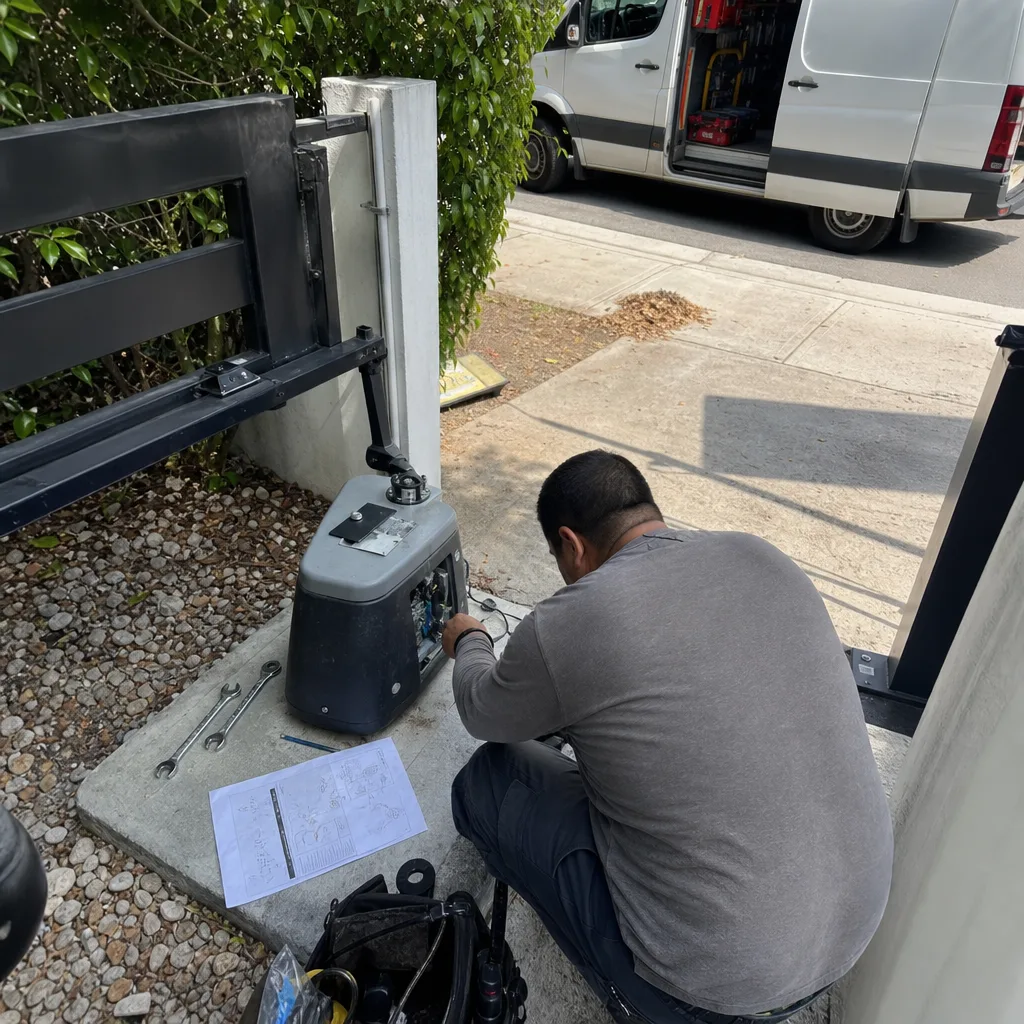
This section describes a safe diagnostic procedure that requires no disassembly of the gate mechanism. You need a digital multimeter with resistance and DC voltage functions, and the operator’s manual for resistance specifications. Do not perform this procedure during gate operation; power down at the breaker and verify with the meter.
Step 1: Identify the motor leads. In the operator control box, the motor connects via two heavy-gauge wires, typically red and black or blue and brown depending on brand. The control board terminals are labeled MOT+ and MOT-, or similar. Disconnect these wires at the board and label them.
Step 2: Measure motor winding resistance. Set the multimeter to ohms. Connect the leads to the two motor wires. Compare the reading to the operator manual specification, typically 3-8 ohms for residential operators. A reading of infinity indicates an open winding (motor failure). A reading near zero indicates a shorted winding (motor failure). A reading 20 percent above specification indicates partial winding degradation; the motor may run but will overheat under load.
Step 3: Measure insulation resistance. Set the multimeter to the highest ohms range. Connect one lead to a motor wire, the other to the motor housing or a known ground point. Any reading below 1 megohm indicates insulation breakdown. This is common in Miami Beach after flooding events or when control boxes seal poorly against salt air. A motor with failed insulation will trip ground-fault interrupters or shock technicians.
Step 4: Test the control board output. Reconnect the motor wires. Set the multimeter to DC volts, appropriate range for the operator (typically 24V or 120V depending on system). Connect the meter across the motor terminals at the board. Command the gate to open. You should see voltage appear within 0.5 seconds of the command, and it should remain stable throughout travel. Voltage that appears then drops, or voltage that is present but the motor does not turn, indicates board failure. Voltage that is correct and stable but the motor does not turn confirms motor failure.
Step 5: Check the capacitor. Single-phase motors use a start capacitor. With power off, discharge the capacitor with an insulated screwdriver across the terminals. Set the multimeter to ohms. The meter should show low resistance that climbs toward infinity as the capacitor charges from the meter’s test current. No change indicates a failed capacitor, which mimics motor failure but costs $15-$40 to replace versus $400+ for a motor.
This five-step sequence takes 15 minutes and prevents the most expensive misdiagnosis in gate repair: replacing a motor when the board or capacitor failed. We teach this procedure to every homeowner who asks, because under Haven Standard Clause 1, an informed customer is less likely to accept an unnecessary repair quote from any company.
Gate Motor & Opener in Miami Beach replacement decisions should be based on evidence, not assumption. Our technicians perform this full sequence and show you the meter readings before recommending any part.
What to Photograph and Record Before Calling a Technician
The most efficient service calls begin with evidence. A technician who arrives to “gate doesn’t work” spends the first 20 minutes gathering what a prepared homeowner could provide in two minutes. The Haven Standard requires our technicians to document what they find; we ask homeowners to document what they observed before we arrive. This creates a complete record and eliminates the ambiguity that leads to unnecessary parts replacement.
Photograph these items:
- The operator control box interior, with the lid open, showing the board, terminals, and any visible damage or corrosion.
- The gate in both fully open and fully closed positions, including the gap between gate and post or the track alignment at both ends.
- Any visible corrosion, cracks, or weld defects on the gate frame, hinges, or track supports.
- The photo-eye alignment (both sender and receiver units) and any obstructions in the beam path.
- The operator’s LED display or any fault code showing at the time of failure.
- The nameplate on the operator showing brand, model, and serial number.
Record these observations:
- Exact symptom description: “press remote, hear click in box, gate does not move” is more useful than “gate broken.”
- Frequency and pattern: “failed three times this morning, worked fine yesterday evening.”
- Environmental conditions: rain, high wind, temperature, time of day. Miami Beach’s afternoon thunderstorms and morning marine layer are relevant data.
- Any recent events: power outage, landscaping work near the gate, vehicle impact, painting or pressure washing.
- Previous repairs: date, company, parts replaced, whether symptoms changed after the repair.
Text or email this package to the technician before arrival. At Vance Gate Repair Miami Beach, we review photos before dispatch and often identify the likely failure category from the evidence, bringing the correct parts on the first visit-see How to Hire a Gate Repair Contractor in Miami Beach: A Step-by-Step Guide for what to expect. This is particularly valuable for Viking and Linear operators where board and motor configurations vary by production year.
The 365-Day Done Right Promise covers all work, but it cannot recover the time lost to a misdiagnosed first visit. Evidence prevents that loss.
Failure Timeline: From First Symptom to Complete Stop
Gate failures do not accelerate linearly. They follow a pattern: subtle degradation, apparent stability, sudden acceleration, total failure. Understanding this timeline helps homeowners decide when to schedule repair versus when to stop using the gate immediately; find more guides & resources in our blog.
| Week | Symptom | Internal Condition | Recommended Action |
|---|---|---|---|
| 1-2 | Hesitation 1-2 seconds, occasional | Motor drawing 150% rated amperage; gearbox lubricant beginning to shear | Schedule maintenance within 10 days. Hinge service and lubrication typically resolves. |
| 3-6 | Hesitation consistent; new grinding sound on acceleration | Worm gear crests flattened; motor operating at 180% rated amperage intermittently | Schedule repair within one week. Gearbox service or replacement. Motor still salvageable. |
| 7-10 | Grinding continuous; intermittent thermal shutdown | Motor windings thermally damaged; gearbox debris circulating in lubricant | Schedule repair within 48 hours. Motor and gearbox likely both required. Board may be stressed. |
| 11-14 | Gate stops mid-travel; requires manual reset | Control board overcurrent protection triggering; limit switches drifting from vibration | Cease automatic operation. Call for emergency service. Risk of board failure and uncontrolled gate movement. |
| 15+ | Complete failure; no response to commands | Multiple component failure; motor seized or board non-functional; possible safety system compromise | Emergency service required. Full diagnostic and likely multiple component replacement. Gate may be inoperable until parts arrive. |
This timeline compresses in Miami Beach’s climate. Salt corrosion and thermal stress accelerate the progression by roughly 30 percent compared to inland locations. A gate that would reach Week 10 in Orlando may reach it in Week 7 in Miami Beach. The apparent stability in Weeks 3-6 is deceptive; internal damage accumulates even when external symptoms seem consistent.
The cost differential is significant. Intervention at Week 2: $140-$220. Intervention at Week 10: $680-$1,400. Intervention at Week 15: $1,200-$2,800 plus potential gate damage from uncontrolled movement. The Haven Standard written price before work starts applies at every stage, but the price itself varies by a factor of ten depending on when you call.
Common Mistakes to Avoid
- Ignoring hesitation because the gate “still works.” Hesitation is the earliest measurable indicator of motor overload. The adaptation period, where homeowners adjust their timing to compensate, typically lasts 4-6 weeks. By then, irreversible thermal damage has occurred.
- Spraying WD-40 on hinges and calling it maintenance. WD-40 is a water displacer, not a lubricant. It evaporates within 72 hours in Miami Beach’s heat and leaves a gummy residue that attracts sand and salt. Use lithium grease or silicone spray specified for gate hardware.
- Assuming intermittent failure will become consistent and easier to diagnose. Intermittent failures worsen nonlinearly. The connection that fails once daily will soon fail ten times daily, then arc-weld itself into a permanent short or open. The diagnostic window closes.
- Power-cycling the operator repeatedly to “clear” a fault. Each reset attempt stresses the control board capacitors and motor start winding. If the gate failed three times with the same symptom, a fourth reset will not fix it. It will damage components that were still functional.
- Accepting a verbal estimate for gate repair. In Miami Beach’s competitive market, some operators quote low verbally and invoice high after “discovering” additional problems. A written scope and price, with part numbers specified, is the minimum documentation standard. This is Haven Standard Clause 1.
- Pressure-washing the gate and operator without covering electrical components. Miami Beach homeowners understandably want to remove salt buildup. Direct water intrusion into the control box, photo-eye housings, or edge sensor conduits causes failures that appear weeks later, complicating warranty claims.
- Delaying corrosion repair on aluminum gates because “aluminum doesn’t rust.” Aluminum does not form iron oxide, but it corrodes galvanically when in contact with steel fasteners, concrete, or salt water. The white powder on aluminum is active corrosion that reduces section thickness. It requires the same attention as rust on steel.
When to Call a Professional
Call a technician immediately if the gate reverses direction unexpectedly, stops and will not respond to commands, makes grinding-then-silence sounds, or shows visible weld cracks or structural deformation. These conditions present safety risks that outweigh any cost consideration. Cease manual operation if the gate feels heavy to move by hand or if the counterbalance system (on vertical lift or bi-fold gates) appears damaged.
For less urgent symptoms, hesitation, intermittent response, or incomplete travel, schedule diagnostic service within the timeframes indicated in the timeline above. Document symptoms with photos and notes before calling.
Vance Gate Repair Miami Beach offers free estimates in Miami Beach. A technician arrives with a multimeter, thermal camera, and the specific service history for your operator brand. The written price is delivered before any work starts, and every visit leaves a documented photo record under Haven Standard Clause 4. Call (786) 371-2767 to schedule.
Frequently Asked Questions
Gate motor repair in Miami Beach typically runs $340-$680 for gearbox service, limit switch replacement, or control board repair. Full motor replacement ranges $680-$1,200 depending on brand and whether the arm bracket and mounting hardware are reusable. Linear and Viking motors fall in the middle of this range; BFT and Ghost Controls units vary by import availability. We provide a written price before any work starts, with part numbers specified. Call (786) 371-2767 for an exact quote on your specific operator, estimates are free.
Yes. A motor drawing excessive amperage overheats the control board’s output relays and can melt solder joints on the power stage. We’ve replaced boards that failed secondary to motor degradation that the homeowner delayed addressing. This is why we measure motor resistance before quoting board replacement; replacing a board without fixing the motor that damaged it wastes the repair. Our diagnostic includes both components, and we show you the meter readings.
Thermal expansion and increased electrical resistance are the primary causes. Aluminum gates expand, changing limit switch timing. Motor windings increase resistance with temperature, drawing more current and heating further. Salt air corrosion accelerates in humidity. In Miami Beach, where summer temperatures reach the low 90s with 80 percent humidity, these effects compound. A gate that fails only in summer has a marginal component that winter temperatures mask.
Measure it. Surface oxidation sits on top of the metal and wipes away with a finger. Pitting creates measurable depth; use a pick or the edge of a coin to feel for craters. Section loss reduces visible thickness at edges or weld joints. Structural compromise shows as cracks, deformation, or movement at connections that should be rigid. When in doubt, photograph the area and text it to a technician before scheduling. We evaluate corrosion photos at no charge and will tell you honestly if it can wait or needs immediate attention.
The operator brand and model from the nameplate, the symptoms with specific timing and frequency, any fault codes displayed, recent weather or power events, and photos of the control box interior and gate condition. This package allows accurate dispatch with correct parts, often enabling same-visit repair. Without it, the first visit may be diagnostic only, requiring a return trip with parts.
We service nine major brands: LiftMaster, FAAC, BFT, Linear, Viking, Ghost Controls, DoorKing, Elite, and Mighty Mule. We do not steer customers toward replacement with a different brand when repair is viable. Our technicians carry common failure parts for all nine brands and can source manufacturer-specific components within 24-48 hours for less common failures. This multi-brand capability matters in Miami Beach, where previous owners may have installed any of these systems and the current homeowner inherits whatever is in place.
The Bottom Line
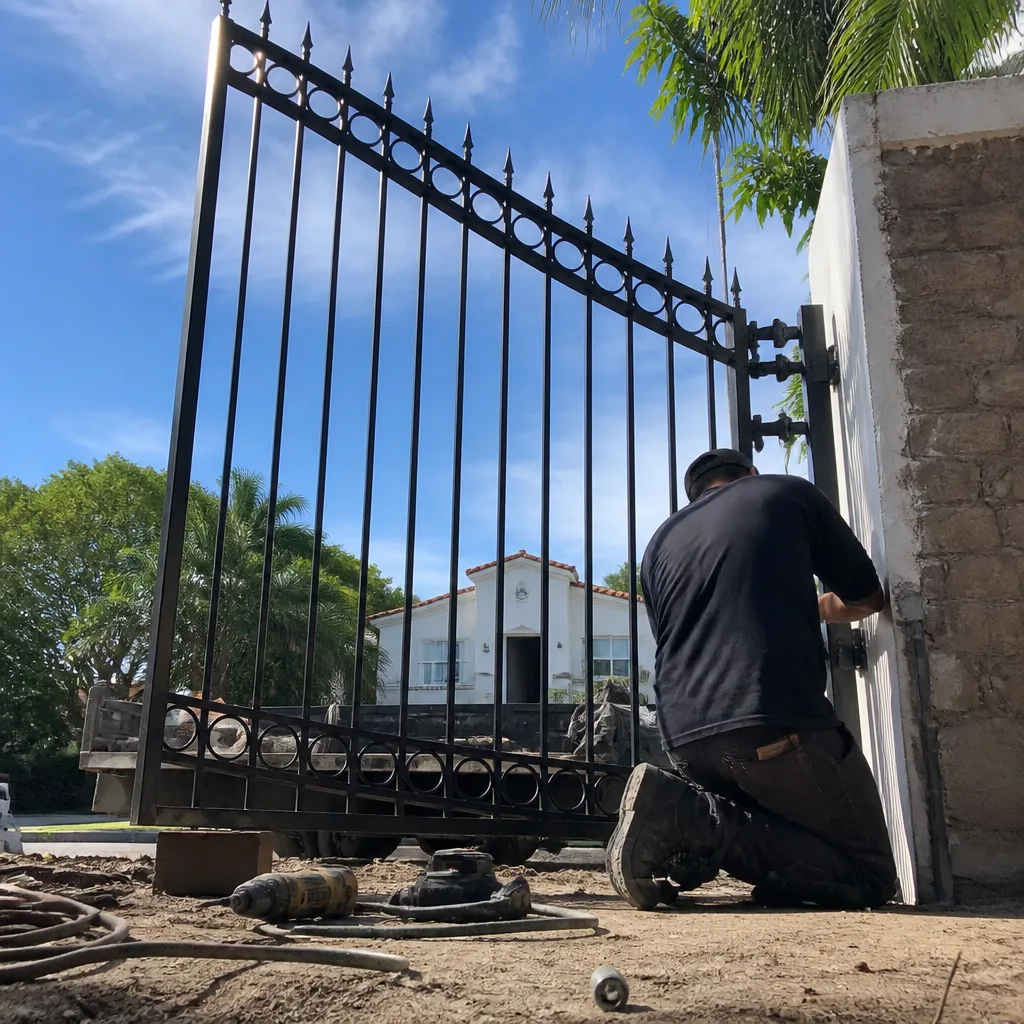
Gate failure in Miami Beach is rarely sudden. It announces itself through hesitation, sound changes, intermittent response, visible corrosion, and travel irregularities that a prepared homeowner can recognize and document. The key is translating these symptoms into specific causes, understanding the accelerated timeline that salt air and heat create, and acting before the failure cascade makes repair uneconomical. A written price before work starts, a documented photo record of every visit, and a 365-day promise to make it right if the repair fails, these are the standards that separate informed service from guesswork. The gate that hesitates today is telling you exactly what will fail tomorrow. Listen, measure, photograph, and call before the Monday morning surprise.
Written by Adrian Vance, Owner at Vance Gate Repair Miami Beach, serving Miami Beach since 2014.